Mother wren frantically follows her wayward babyFor the past four or five years a brown wren has nested in Aunt Mel’s garage. Her nest is located inside a silver metal bucket hanging on a hook near the garage door. The wren flies in and out of the garage with twigs and hay building the perfect nest for her babies.
Once the chicks hatch, mother wren stays busy delivering bugs to the hungry bunch. She chirps once as she enters the garage to announcing her return. The babies get so excited the bucket sways from side to side.
This goes on until the babies are able to survive on their own. One morning, Aunt Mel raised the garage door and the babies were gone. She seldom sees them but often hears them singing in the trees.
But this year was a little different. Aunt Mel watched one intrepid baby as it left the bucket-nest for the first time. The baby wren flew from the nest, brushed past Aunt Mel and landed on the hammock stand. He didn’t fly well and he probably didn’t mean to land on the hammock. But he was chirping and looking around and obviously pleased with his flight to freedom. Mother wren, however, was a nervous wreck.
As he flitted across the yard on brief spurts of flight, she frantically followed behind, a big bug in her beak like a bribe for him to come back. But he didn’t give her a second look and continued exploring his new world. Mom was right behind him. Aunt Mel wondered how long mother wren followed her independent minded baby. It must be hard when the last one leaves the nest. But next spring, she’ll be back to raise a new flock of little brown wrens.
The driveway to Aunt Mel’s farm is very long. Two overgrown fence lines and large unkept pastures flank it. Leaving the woods, the deer often walk along the drive on their way to feast in the neighbor’s apple trees. Usually they move at dawn or dusk but sometimes they’re out in the middle of the afternoon.
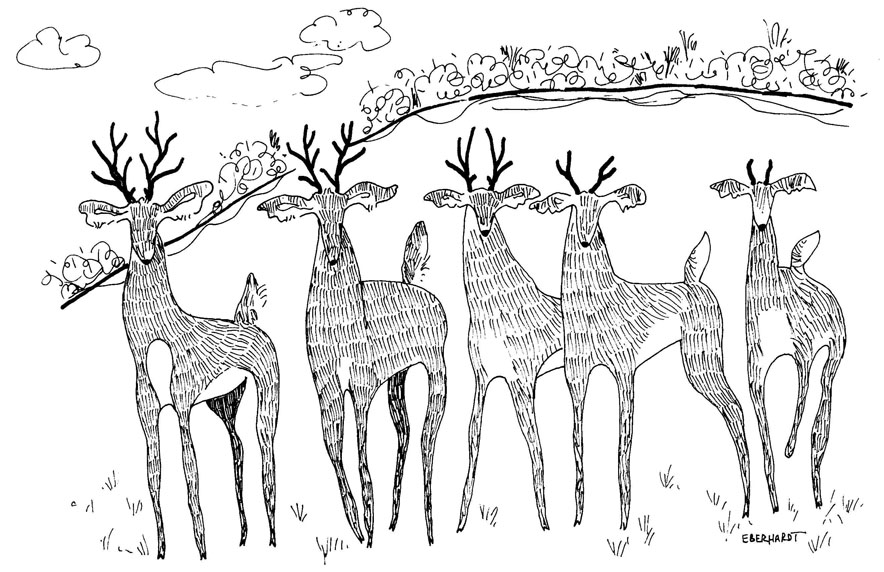
Returning from errands, one hot summer afternoon, Aunt Mel had to slam on her breaks to avoid hitting deer in her driveway. Five large bucks were headed toward the apple trees. They stopped for a minute to make certain Aunt Mel was not a threat. Once assured, they hopped the fence in front of the truck and continued on their way.
The leader was a very large buck with a rack of at least six or eight points. The bucks that followed were progressively younger, with smaller and smaller racks. The last deer barely had a stub with two points. Their antlers still growing, soft, thick and fuzzy. In the summer, the male deer will bond and form a temporary herd, as there is safety in numbers. They live together until mating season late in the fall. The older bucks teaching the younger ones how to survive.
They five bucks were magnificent and Aunt Mel hopes to see them again.
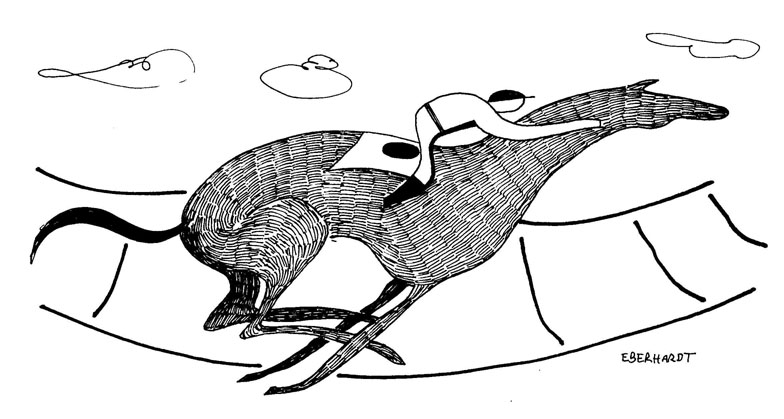
Bubba is Aunt Mel’s newest horse. He is a Thoroughbred, a racehorse, who had a successful career as a sprinter. Before he was 2, he went to school to learn to race. He was broke for riding, learned to leave the starting gate and how to move around the track. Within a few months, he went to the track and started racing. Thoroughbred’s start working when they are very young. They have hardly begun growing when they start the hard routine of track life.
Bubba raced well, but soon a piece of bone broke off inside his leg. It was very painful. The bone chip floated inside his leg making it tender to step. With several months off, it was likely the bone chip would simply re-attach along his leg bone and heal. Bubba was sent home to spend the winter in a pasture.
As the weather warmed, the vet came out to the farm to x-ray Bubba’s leg. The chip had reattached and Bubba was cleared to return to the track to race.
He was still a baby, barely 3, when he started to race again. He ran short races that focused on speed – Bubba was a sprinter. He raced a lot, 36 times in less than 2 years. But he loved his job and he was good at it. In almost every race, Bubba placed first, second or third and made a lot of money for his owner and trainer.
Sadly, one day, Bubba’s owner died. It was very unexpected. The family had no interest in Bubba and told the trainer to sell him. Aunt Mel saw his photo and fell in love. She bought Bubba without ever meeting him.
Bubba had one last race. He was the favorite and came out of the starting gate in the lead. He led the entire race and near the finish line another horse ran up alongside. It was a photo finish.
Bubba came in second by a nose!
The next day our friends loaded Bubba on the trailer and he came to Georgia. The following day, Aunt Mel and Bubba enjoyed their first ride together.
Horses are designed to graze. They eat small bits of food all day long. Long ago, the horses ate all the grass in their day pasture so Aunt Mel makes certain they always have a supply of hay on which to munch.
Hay can be bought in square bales. They weigh about 75 pounds. Depending on the density of each flake, a square bale may last two days. Aunt Mel stores a weeks supply of square bales in her garage. They take up a lot of room and make a mess.
So usually Aunt Mel buys a big round bale of hay. A round bale is a spiral collection of loose hay that is bound together by string mesh. Round bales weigh about 600 pounds and will last almost 2 weeks. They are left out in the pasture for the horses to eat at will. Round bales are best because the horses can graze all day.
Sounds like a win, win for everyone except for one factor. The horse’s day pasture is a slight hill. Aunt Mel totes the round bale in her red trailer, carefully driving through the pasture to the unloading area behind the well. The ground is just a little flattered and supported by large wooden poles on both sides, the round bale stays in place.
Except when GiGi has an itchy butt. When GiGi needs to scratch her backside, she backs into the round bale, leans back and sways from side to side against the hay. The strands do a sufficient job of itching. But one day she leaned back a little too hard. In her itching zeal, she pushed the bale over the pole. It rolled down hill unraveling until there was no more round bale. Instead, there was a four foot wide, one foot thick layer of hay that went about 25 yards across the pasture. Aunt Mel was so mad!
The horses only ate part of the unraveled hay. Instead they used the hay as a soft bed for napping and as a bathroom area. Most of the hay was wasted just because GiGi had an itchy backside. Next time Aunt Mel bought a round bale, it was supported by much larger wooden poles.
One cold October morning, Aunt Mel heard a little dog barking while she was feeding the horses. She looked around and spied a little brown dog staring at her from the rental house next door. The dog barked for a while but no one came out of the house to check on it.
During the next few days, the little dog barked when Aunt Mel was working in the yard. Aunt Mel started to wonder if anyone was still living in the house? Surely they wouldn’t move and leave their dog behind?
A few more days passed, it was clear the house was empty. It had been over a week, cold and rainy. The little dog still barked at Aunt Mel. Aunt Mel got in her truck and drove over to the house.
The people were long gone and had trashed the house; removing screens, breaking the porch rails, toys and household garbage was left strewn across the yard. Aunt Mel tiptoed to the back of the house and found the little dog.
The people had constructed a 3 x 3’ cage out of chicken wire and broken bits of wood. It had no roof, and inside, no shelter. There was no bowl for water or food, just the little brown dog fearfully scrunched in the far corner. He was shaking and very thin.
Aunt Mel broke the door and the little dog bolted into her arms. She drove straight to the vet’s office.
The vet determined that the dog was about 6 months old. He was malnourished and only weighed 8 lbs. He should have weighed three times that. The puppy was carefully examined and found healthy except for the obvious neglect. He was given necessary shots and a bag of good puppy food. When paying the vet for their services, they asked “what’s the puppy’s name?”
Aunt Mel answered without hesitation, “Lucky!”
Lucky had a new home at Aunt Mel’s farm. In a few months, he had grown to a normal weight for his age. For a dog raised outside with little human contact or training, he immediately took to living inside and sleeping in bed with Aunt Mel.
He is still fearful of children and strangers. But once he meets you, you are a friend for life. He never forgets someone he meets. It is remarkable that someone left him in a cage without food or water. Luck was certainly on Lucky’s side when Aunt Mel rescued him from the horrible, little cage.
Aunt Mel was very excited when her first horse, GiGi, was bred to a beautiful Arabian stallion named Kantos. GiGi grew bigger and bigger as her due date drew near. At the time, GiGi and Kain were boarded at a private barn in Roswell. Aunt Mel was well prepared for the baby and planned to be at the barn to see the entire event.
But GiGi had other plans. She gave birth to Nettie a month early in the middle of the night. Aunt Mel received a call from the barn manager at 6 a.m., “come to the barn, there’s a surprise waiting for you in GiGi’s stall.” Aunt Mel couldn’t get to the barn fast enough.
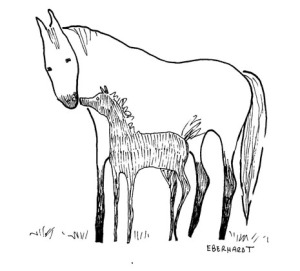
GiGi was standing over a little red baby. The baby was sound asleep having already stood and nursed, she was ready for a nap. She was bright red with a white strip and pink nose. She was the size of a baby deer and mostly long legs. Aunt Mel petted GiGi and told her she was a good girl.
When the baby woke from her nap, Aunt Mel petted and played with her. She was very sweet and loved the attention. But she loved to eat more. She nursed frequently and GiGi took very good care of her. They had an immediate strong bond.
GiGi taught Nettie may things. She was taught to poop along the left side of her stall, starting in the back corner and pooping in piles toward the front. She was taught horse language so she would get along in the herd. For instance, rolling your head means “move” to horses. GiGi and Nettie never hesitate to roll their heads at Kain or Joe, telling them to move away from the hay or else! Nettie is very bright and a pleasure to manage thanks to GiGi’s instructions.
Nettie grew quickly and as she grew, she also changed color. By her third birthday she was grey like her mother. Unlike her dainty mother, she was much bigger – taller, wider, stronger.
GiGi and Nettie spend their days in the pasture with Kain and Joe and sometimes other horses. They always stick together, like a team, eating side by side, snoozing side by side. When Nettie is really tired and lies down to sleep, GiGi stands guard over her.
Nettie loves her mother and does as GiGi dictates. She doesn’t mind taking orders from her mother but she seems to enjoy breaks when she works with Aunt Mel in the other pastures. GiGi yells at her over the fence and Nettie always nickers back to assure her mother that she’s ok with Aunt Mel.
It is hard to imagine life without the two pasture bosses, GiGi and Nettie. It makes Aunt Mel happy that mother and daughter are able to spend their entire lives together. They rule the pasture and the farm. They are two very happy, beautiful Arabian mares.
When Peep first arrived at Aunt Mel’s farm, she had no way of knowing if this beautiful cockatiel was a boy or girl. But Peep soon showed her gender. Miss Peep regularly lays eggs.
Each egg is smooth and warm and white. They are the size of your thumbnail. She lays between 3 and 7. She clears a spot in a corner on the floor of her cage and arranges the eggs carefully beneath. She sits all day warming the eggs, moving they around with her beak, and serving her role as diligent mother. But they never hatch because they are unfertilized.
Eggs usually take 21 days to hatch. When the first egg appears, Aunt Mel marks her calendar. On the 21st day, she removes the eggs so Miss Peep thinks her eggs have hatched. This seems to be a good arrangement. Miss Peep often seems relieved of this duty. She spends the next few days talking, preening and eating and enjoying a good head scratching.
Miss Peep’s eggs are delicate examples of the strength of nature and motherhood.
Aunt Mel’s horses are very nosey. They enjoy watching the neighborhood children jump on their trampoline. They spend summer evenings watching the neighborhood men play volleyball. If someone starts to drive down Aunt Mel’s long driveway, they run to the fence and stare. But lately they’ve been particularly glued to the fence, completely entranced by the latest goings on.
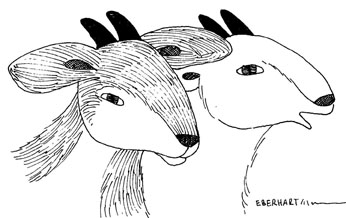
Two goats moved in next door.
And the goats seem mutually interested in Aunt Mel’s horses. They hang out at the fence nibbling honey suckle. They reach through the boards to touch noses with the horses. At night they curl up in the undergrowth and sleep near the horses.
At least for a while, the goats hold a fascination for the horses. Apparently goats are to horses like TV to humans – something interesting to watch when there isn’t much else to do.
One day Aunt Mel was enjoying a hot cup of coffee swinging in her hammock under the big Maple tree. The animals were still eating their breakfast. The sun was just starting to warm for the day. As Aunt Mel enjoyed the peace and quiet, she suddenly caught a whiff of a terrible smell.
What the heck is that awful smell? It stunk so badly, Aunt Mel couldn’t finish her coffee. She got up and walked around the yard searching for the source of the nauseating stink.
As she walked around the big blue hydrangea, she spotted a big orange cat that she had never before seen. The cat was watching Aunt Mel and was not frightened. Instead he stood and walked right up to Aunt Mel. He meowed and began to rub against her legs for a pet.
He was a beautiful, long hair orange cat with green eyes. A very friendly cat but scruffy from neglect. Probably tossed along the road as an unwanted pet, the orange cat had naturally wandered to Aunt Mel’s farm. As Aunt Mel leaned over to welcome the cat, she was overwhelmed by that stink.
Oh dear. The stink was the nice orange cat. What the heck is wrong that he smells so bad? Aunt Mel breathed through her mouth and she inspected the cat. Maybe he had a terrible infection that was rotten? But that wasn’t the problem, the stink source was simple.
The orange cat had globs of poop stuck to the long hair on his back legs. His entire back end was caked with wretched smelling poop. Aunt Mel got a pair of scissors and cut the stink away. She took the cat into the house and gave him a bath. As she toweled the orange cat dry, he purred and meowed his appreciation.
Aunt Mel wondered if the poop smell could be the reason someone tossed this nice cat aside? They were too lazy to help the longhaired cat clean himself? Well he was welcome at Aunt Mel’s Farm. She would help him stay clean and stink free.
Orange Cat lived at Aunt Mel’s Farm for several years. She took him to the local dog groomer and kept him clipped like a poodle. His short hair prevented the poop from sticking to his legs so he was never again the source of a bad stink.

 Bubba is Aunt Mel’s newest horse. He is a Thoroughbred, a racehorse, who had a successful career as a sprinter. Before he was 2, he went to school to learn to race. He was broke for riding, learned to leave the starting gate and how to move around the track. Within a few months, he went to the track and started racing. Thoroughbred’s start working when they are very young. They have hardly begun growing when they start the hard routine of track life.

 Horses are designed to graze. They eat small bits of food all day long. Long ago, the horses ate all the grass in their day pasture so Aunt Mel makes certain they always have a supply of hay on which to munch.
 One cold October morning, Aunt Mel heard a little dog barking while she was feeding the horses. She looked around and spied a little brown dog staring at her from the rental house next door. The dog barked for a while but no one came out of the house to check on it.
 When the baby woke from her nap, Aunt Mel petted and played with her. She was very sweet and loved the attention. But she loved to eat more. She nursed frequently and GiGi took very good care of her. They had an immediate strong bond.
 Each egg is smooth and warm and white. They are the size of your thumbnail. She lays between 3 and 7. She clears a spot in a corner on the floor of her cage and arranges the eggs carefully beneath. She sits all day warming the eggs, moving they around with her beak, and serving her role as diligent mother. But they never hatch because they are unfertilized.
 Georgia summers are hot but Lyndon has learned that his drinking hole is also a refreshing means to cool off overheated pigs.
 Aunt Mel’s horses are very nosey. They enjoy watching the neighborhood children jump on their trampoline. They spend summer evenings watching the neighborhood men play volleyball. If someone starts to drive down Aunt Mel’s long driveway, they run to the fence and stare. But lately they’ve been particularly glued to the fence, completely entranced by the latest goings on.
 As she walked around the big blue hydrangea, she spotted a big orange cat that she had never before seen. The cat was watching Aunt Mel and was not frightened. Instead he stood and walked right up to Aunt Mel. He meowed and began to rub against her legs for a pet.